How to Make Tea: A Simple Step-by-Step Guide
A satisfying cup depends on suitable tea, fresh water, the right amount of leaf, and proper timing. The same method works across tea varieties.
This tea guide explains how to make tea for one cup or a full pot with loose leaves or bags. It also covers temperature, ratios, additions, and common mistakes.
Understanding how to steep tea is mainly a matter of matching heat and time to the chosen leaves.
Quick answer: For one 8-fluid-ounce (240-milliliter) cup, one tea bag or about 2 to 3 grams of loose leaf tea is a sensible starting point. Fresh water is heated to suit the variety, poured over the tea, and left for roughly 2 to 5 minutes. The leaves or bag are then removed before the drink is served.
What Is Needed to Make Tea?
Essential ingredients
Only tea and water are essential. Black, green, white, oolong, and pu-erh come from the Camellia sinensis plant, while chamomile, peppermint, rooibos, and fruit blends are herbal infusions. Bags offer speed; loose leaves provide more control and need room to unfurl.
Fresh water matters because it forms almost the entire drink. A filter can help when tap water tastes strongly of chlorine or leaves a mineral film. Milk, sugar, honey, lemon, and spices are optional.
Useful tea-making equipment
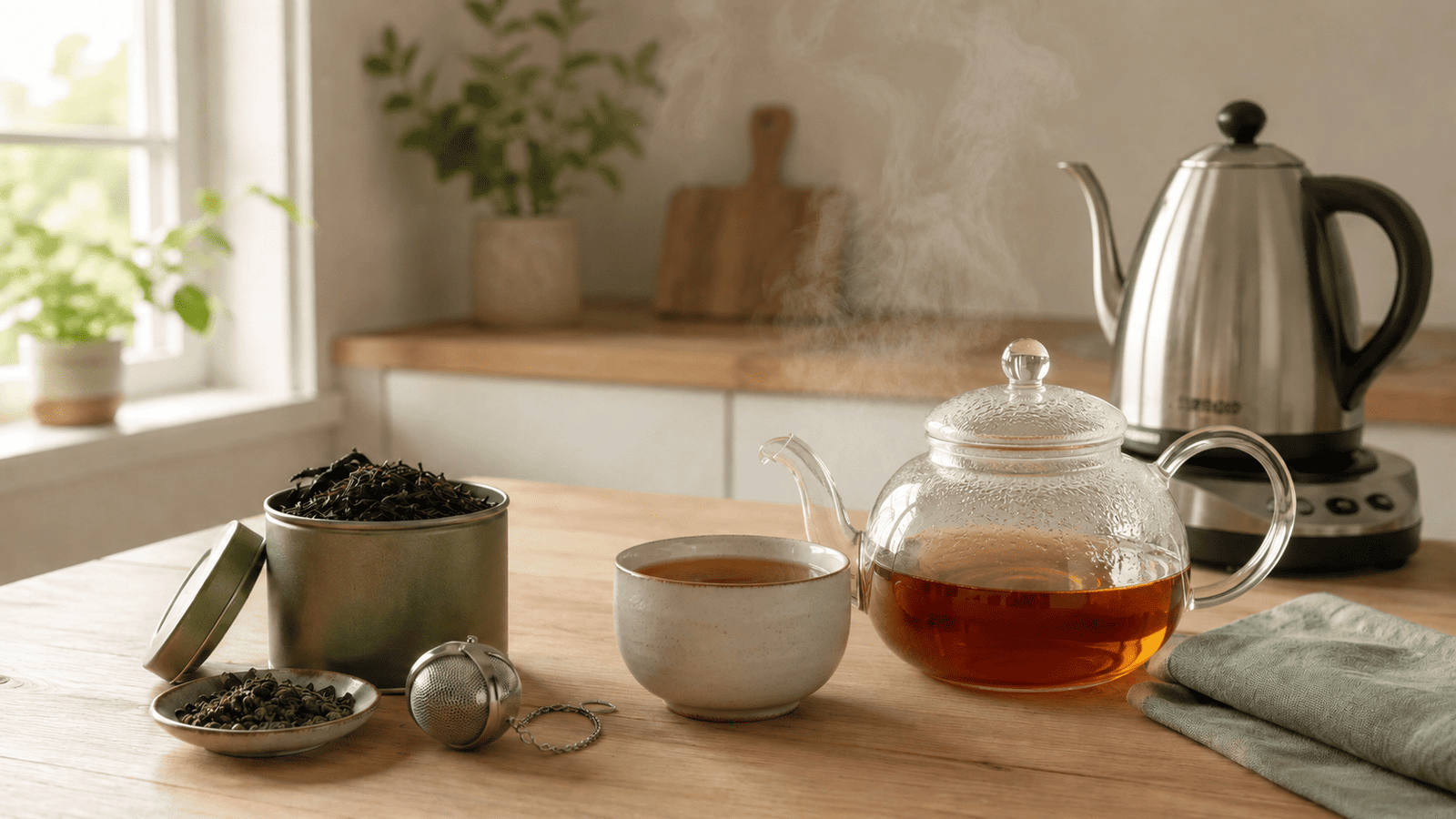
These tea essentials are simple. A kettle is convenient, but a saucepan works as well. One cup needs a mug, timer, and bag or roomy infuser. A larger batch is easier in a teapot with a basket or separate strainer. A thermometer helps with delicate leaves but is not essential for tea for beginners.
How to Make Tea in 6 Simple Steps
Step 1: Choose the type of tea
Flavor should guide the choice. Black tea is robust and often paired with milk. Green tea is lighter and dislikes excessive heat. White tea is delicate, oolong ranges from floral to roasted, and pu-erh tends to be earthy. Herbal blends may be minty, spicy, floral, or fruity.
Learning how to make herbal tea generally means using hotter water and allowing a longer infusion than a delicate green tea needs.
Package directions deserve priority because finely cut leaves generally infuse faster than large whole leaves.
Step 2: Use fresh water
The kettle should hold only the amount required. When tap water tastes good on its own, it will usually make good tea. Otherwise, a basic filter may improve the cup more than extra sweetener could.
Step 3: Heat the water to the correct temperature
The correct water temperature for tea depends on the variety. Black tea and most herbal infusions tolerate water close to boiling. Green and white teas usually taste smoother with cooler water. Oolong falls between those ranges, although darker oolongs can take more heat.
Without a thermometer, boiled water can rest briefly before reaching delicate leaves. About two minutes in an open kettle is a useful starting point for green tea, but package instructions remain the best guide for a particular product.
Step 4: Measure the right amount of tea
For an 8-fluid-ounce cup, one bag or 2 to 3 grams of loose leaves suits most styles. That is roughly one rounded teaspoon, although bulky white leaves and rolled oolong make a scale more consistent.
Anyone learning how to brew strong tea will get a cleaner flavor by adding more leaf instead of extending the steep far beyond the recommended time. More time often extracts extra bitterness along with strength.
Step 5: Steep for the right amount of time
To steep tea evenly, water is poured directly over the leaves. The vessel may then be covered, particularly for herbal infusions. When brewing tea, timing begins as soon as water meets the leaves.
Most green teas need 2 to 3 minutes; many black and oolong teas need 3 to 5. Herbal and fruit blends often need 5 to 7. A shorter infusion is gentler, while a longer one adds body until bitterness begins to dominate.
Step 6: Remove the tea and serve
The bag, basket, or leaves should be removed when the timer ends. Otherwise, extraction continues and a pleasant drink can become harsh. A bag may drain without aggressive squeezing, which can push fine particles and concentrated liquid into the cup.
Milk or sweetener is added after tasting so the original flavor can be judged first.
Tea-to-Water Ratio: How Much Tea per Cup?
| Method | Tea amount | Water amount | Practical note |
| Tea bag | 1 bag | 8 fl oz / 240 ml | Use a larger mug only if the flavor remains strong enough. |
| Loose leaf | 2-3 g, about 1 rounded tsp | 8 fl oz / 240 ml | A scale is more accurate than a spoon. |
| Small teapot | 2 bags or 4-6 g | 16 fl oz / 475 ml | Keep the same ratio as the pot becomes larger. |
| Iced tea concentrate | 2 bags or 4-6 g | 8 fl oz / 240 ml hot water | Pour over a full glass of ice after steeping. |
This loose leaf tea-to-water ratio is deliberately moderate. Because leaf shapes vary, how much loose leaf tea per cup is answered most consistently by weight: about 2 to 3 grams per 240 milliliters. That also provides a clear answer when comparing grams of tea per cup.
Water Temperature and Steeping Time by Tea Type
The best tea temperature protects aroma while extracting enough flavor. These ranges are household starting points rather than rigid rules.
| Tea type | Water temperature | Typical steeping time | Expected character |
| Black tea | 200-212°F / 93-100°C | 3-5 minutes | Full, brisk, and robust |
| Green tea | 165-185°F / 74-85°C | 2-3 minutes | Fresh, vegetal, or gently sweet |
| White tea | 170-185°F / 77-85°C | 3-5 minutes | Delicate, soft, and lightly floral |
| Oolong tea | 185-205°F / 85-96°C | 3-5 minutes | Floral, creamy, toasted, or roasted |
| Pu-erh tea | 200-212°F / 93-100°C | 3-5 minutes | Earthy, deep, and rounded |
| Herbal or fruit infusion | 212°F / 100°C | 5-7 minutes | Bold aroma and full ingredient flavor |
The UK Tea & Infusions Association recommends approximately 90-98°C for black tea and around 80°C for green tea, while also advising drinkers to follow the packet. That combination is sensible: a chart begins the process, but taste completes it.
How to Make Tea Using Different Methods
How to make tea with a tea bag
One bag is placed in a mug and covered with the appropriate amount of hot water. After the stated tea steeping time, the bag is removed. It should move freely rather than being pinned beneath a spoon. For more strength, a second bag is preferable to an excessively long infusion.
How to brew loose leaf tea
Learning how to make loose leaf tea begins with a roomy basket infuser. Measured leaves go into the basket, hot water is poured over them, and the basket is lifted out on time. Fine leaves need close mesh. Some whole-leaf green, white, and oolong teas can be infused again.
How to use a teapot
The pot may be warmed with hot water and emptied first. Tea and water are measured according to its actual capacity. The entire infusion is poured or strained when ready so the leaves do not continue steeping.
For anyone asking how many tea bags for a pot of tea, the reliable rule is one bag for each 8 fluid ounces or 240 milliliters of water. An extra bag is optional when a notably strong black tea is wanted.
How to make tea without a kettle
A saucepan is the best alternative. Water is heated to the right temperature, the pan is removed from the burner, and the water is poured over tea. When making tea on the stove, leaves should not boil continuously unless a recipe such as masala chai calls for simmering.
A microwave can heat water in a microwave-safe mug, but temperature control is less predictable. Short intervals and careful handling help. A kettle is normally used for water only; leaves should not go inside unless the appliance was designed for brewing.
How to Make One Cup or a Full Pot
For one cup of tea, the ratio is one bag or 2 to 3 grams of leaf in 240 milliliters of water. For a pot, both quantities increase together. A 720-milliliter pot starts with three bags or 6 to 9 grams of loose leaf.
A ceramic teapot can be prewarmed and fitted with a removable strainer. Before several people are served, the finished infusion can be gently stirred so its strength is even.
Adding Milk, Sugar, and Other Flavors
Milk suits strong black teas such as breakfast blends and Assam. It is usually added after the leaves are removed. A British-style cup commonly follows that pattern: black tea, freshly heated water, a 3- to 4-minute infusion, and milk to taste.
Sugar and honey dissolve best in a hot drink. Lemon brightens black and green tea but may curdle dairy milk. Cinnamon, ginger, cardamom, mint, vanilla, and citrus peel add aroma. The best answer to how to make tea taste better is to correct water, temperature, ratio, and time before relying on flavorings.
Common Tea-Making Mistakes to Avoid
- Using the same temperature for every variety: Near-boiling water can flatten delicate green tea, while lukewarm water may leave black or herbal tea thin.
- Guessing the water volume: A large mug can dilute one bag. Measuring the mug once makes later cups easier.
- Steeping for too long: Extra time does not create only strength; it can also increase bitterness and astringency.
- Using too little leaf: A weak drink is better corrected with more tea at the next attempt, not endless brewing.
- Crowding loose leaves: A tiny infuser limits water circulation and prevents larger leaves from opening.
- Leaving the bag in the cup: The flavor continues to change until the bag is removed.
- Adding milk before brewing is complete: Cooler water and diluted contact can slow extraction, especially when the bag sits directly in the mug.
Expert Tips for a Better Cup
A timer is more reliable than color alone. Notes on quantity, temperature, and time make a favorite result repeatable. Tea also stays fresher in an airtight container away from heat, light, moisture, and strong odors.
If a cup tastes bitter, cooler water or less time may help. If it tastes watery, more leaf is usually the first adjustment.
What About Iced Tea and Cold Brew Tea?
Traditional iced tea can be made as a double-strength hot infusion poured over ice. To make iced tea with tea bags, two bags can be used per 240 milliliters of hot water, steeped for the normal time, removed, and cooled promptly.
Sweet tea is usually sweetened while the hot concentrate is still warm, then diluted and chilled.
Cold brew tea is a separate method. Clean equipment and continuous refrigeration are important. South Dakota State University Extension advises keeping cold preparations below 40°F (4°C) in a sanitary container. Ratios and timing belong in a dedicated cold-brew guide.
Frequently Asked Questions
How long to steep tea?
The usual range is 2 to 5 minutes, although herbal and fruit blends may need 5 to 7. The variety and package directions determine the best starting point.
How long does it take to make tea?
Most cups take 5 to 8 minutes from filling the kettle to removing the leaves. Infusion usually lasts 2 to 5 minutes; herbal blends may need up to 7.
How can someone tell when tea is done?
Time and taste are more dependable than color. A small spoonful can be tasted near the lower end of the range, followed by 30-second intervals if needed.
Should tea bags go into boiling water?
Black and many herbal bags can take near-boiling water. Green and white bags generally taste better with cooler water. The label should settle uncertainty.
How long should a black tea bag steep?
Three to five minutes is useful. Fine-cut breakfast tea may be ready near three; a fuller cup may need four or five. Roughness or dryness signals excessive time.
How long should a green tea bag steep?
Two to three minutes at 165-185°F (74-85°C) is a practical start. Cooler water and shorter timing usually make a sweeter cup.
Is milk added before or after tea?
For a bag in a mug, milk is best added after removal. With a finished pot, either order works, although milk last makes strength easier to judge.
Can tea leaves be steeped more than once?
Many whole-leaf oolong, green, white, and pu-erh teas produce several infusions. Later rounds may need slightly more time. Most finely cut bags are intended for one use.
What is the healthiest way to prepare tea?
Plain tea avoids added sugar and keeps its original flavor clear. Harvard’s Nutrition Source notes that a splash of milk can still fit a healthful drink, while the FDA advises limiting added sugars within the overall diet. Medical needs and caffeine sensitivity still matter.
Simple Tea Recipe
Ingredients
- 1 tea bag or 2-3 grams of loose leaf tea
- 8 fluid ounces (240 milliliters) fresh water
- Milk, lemon, sugar, or honey, if desired
Instructions
- The water is heated to the range recommended for the chosen tea.
- The bag or loose leaves are placed in a mug or infuser.
- Hot water is poured directly over the tea.
- The infusion is timed for 2 to 5 minutes, or according to the package.
- The bag or leaves are removed, and optional additions are stirred in after tasting.
Notes
For a stronger drink, more tea should be used before more time is added. For a smoother drink, the next cup can be steeped for less time or at a slightly lower temperature.
Final Thoughts on Making the Perfect Cup of Tea
Good tea comes from repeatable choices. Fresh water, a suitable temperature, a measured ratio, and a timer provide control. Milk, sweetness, strength, and flavor can then be adjusted to suit the drinker.
Sources
- UK Tea & Infusions Association, “The Perfect Brew”: View source
- Harvard T.H. Chan School of Public Health, “Tea – The Nutrition Source”: View source
- S. Food and Drug Administration, “Added Sugars on the Nutrition Facts Label”: View source
- South Dakota State University Extension, “How to Make Cold Brewed Teas Safely”: View source