Tea Infuser vs Tea Strainer: What's the Difference and Which Is Better?
A practical guide to choosing loose-leaf tea tools
Tea Infuser vs Strainer: Quick Comparison
| Feature | Tea infuser | Tea strainer |
| Main job | Holds leaves during steeping | Filters leaves during pouring |
| Position | Sits inside a mug or teapot | Sits over a cup or inside a teapot spout |
| Best suited to | One cup, office brewing, precise timing | Full teapots, traditional service, free-leaf brewing |
| Leaf movement | Depends on the size of the chamber | Usually unrestricted inside the pot |
| Stopping the brew | Removal separates leaves from water | Requires the pot to be fully poured or decanted |
| Typical forms | Basket, tea ball, tong, stick, built-in basket | Handheld sieve, spout filter, fine-mesh strainer |
| Cleanup | Leaves stay mostly contained | The pot and strainer both need emptying |
The table also reveals why product names can be confusing. A deep mesh basket may be sold as a “basket strainer,” yet it functions as an infuser when it rests in hot water with tea inside. Function is therefore more reliable than the wording on the package.
What Is the Difference Between Tea Infuser and Strainer Tools?
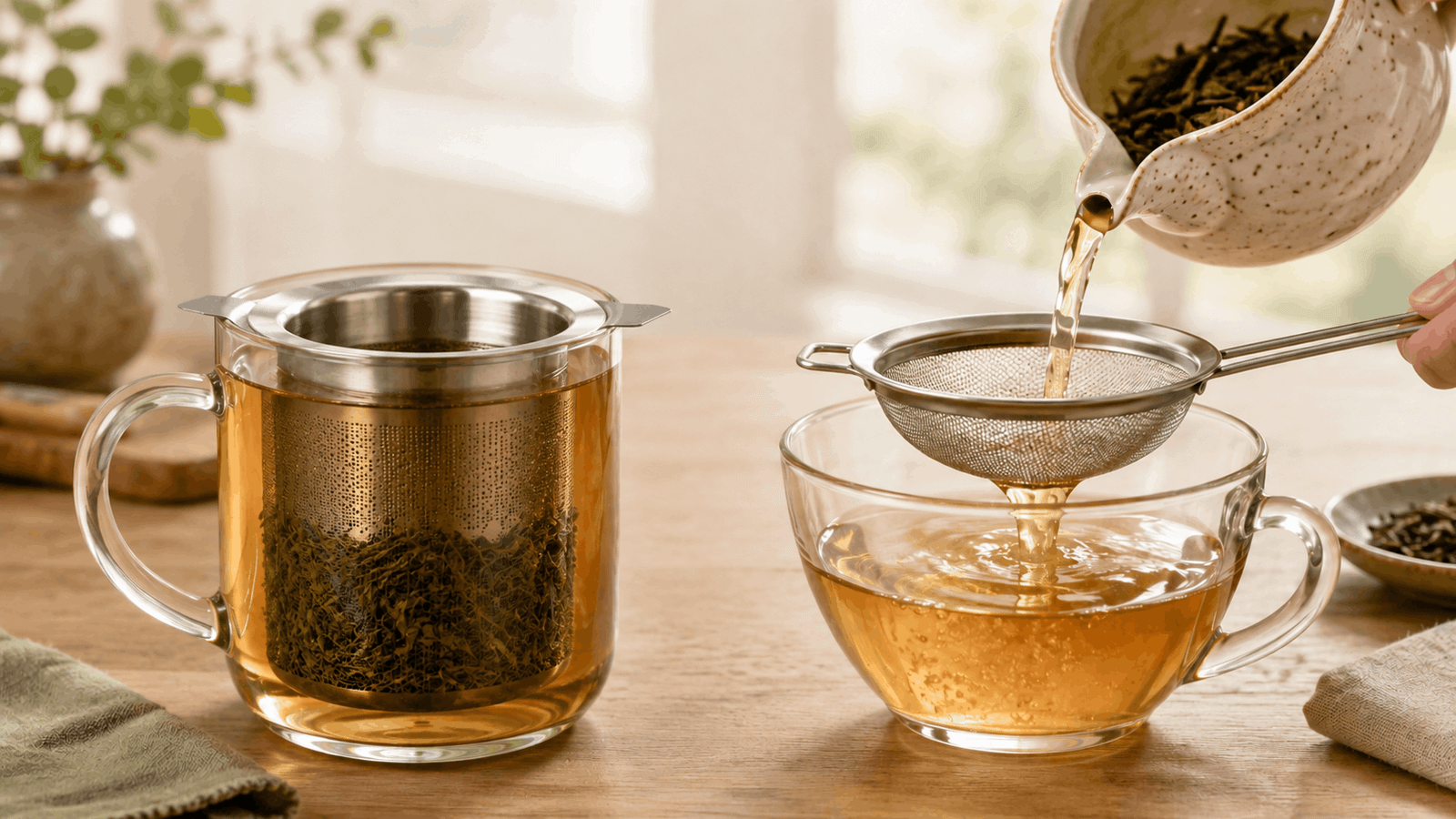
The simplest distinction is containment versus filtration. An infuser contains dry tea leaves before hot water is added and remains in the vessel while flavor is extracted. Once the desired steeping time has passed, the whole container is lifted out.
A strainer normally enters the process later. Leaves are placed directly in a teapot, where they move through the water without a container. The brewed liquid then passes through the strainer on its way to the cup, leaving the leaves behind.
This creates one practical difference that is often missed: removing an infuser stops most contact between the leaves and water immediately. A strainer does not stop extraction while tea remains in the pot. When a large pot will not be emptied at once, the liquor should be poured into a separate serving pot or pitcher so the remaining cups do not become overly strong or bitter.
What Is a Tea Infuser?
A tea infuser is a perforated or mesh holder designed for steeping loose tea. Common versions include cylindrical baskets, folding tea balls, tong-style infusers, silicone shapes, and removable baskets supplied with mugs or teapots. The historic tea egg and tea ball follow the same basic principle: leaves are immersed in water inside a removable container.
The best loose leaf tea infuser is usually wide and deep enough to let wet leaves open without becoming tightly packed. Water needs to enter, circulate around the leaf surfaces, and leave the chamber freely. A cramped tea ball may still handle a small amount of finely cut black tea, but it is less suitable for large white tea leaves, twisted oolong, flowering ingredients, or rolled leaves that expand considerably.
Advantages of an Infuser
- It provides direct control over steeping time.
- It keeps most leaves contained from beginning to end.
- A basket can move easily from a mug to a drip tray.
- It suits a single serving without requiring a teapot.
- Fine mesh can reduce small particles in the cup.
Limitations of an Infuser
Its performance depends heavily on size and mesh. A shallow basket may sit above the waterline in a large mug, while very fine mesh can drain slowly or trap tiny leaf fragments. Small hinged balls can also be fiddly to fill and clean.
What Is a Tea Strainer?
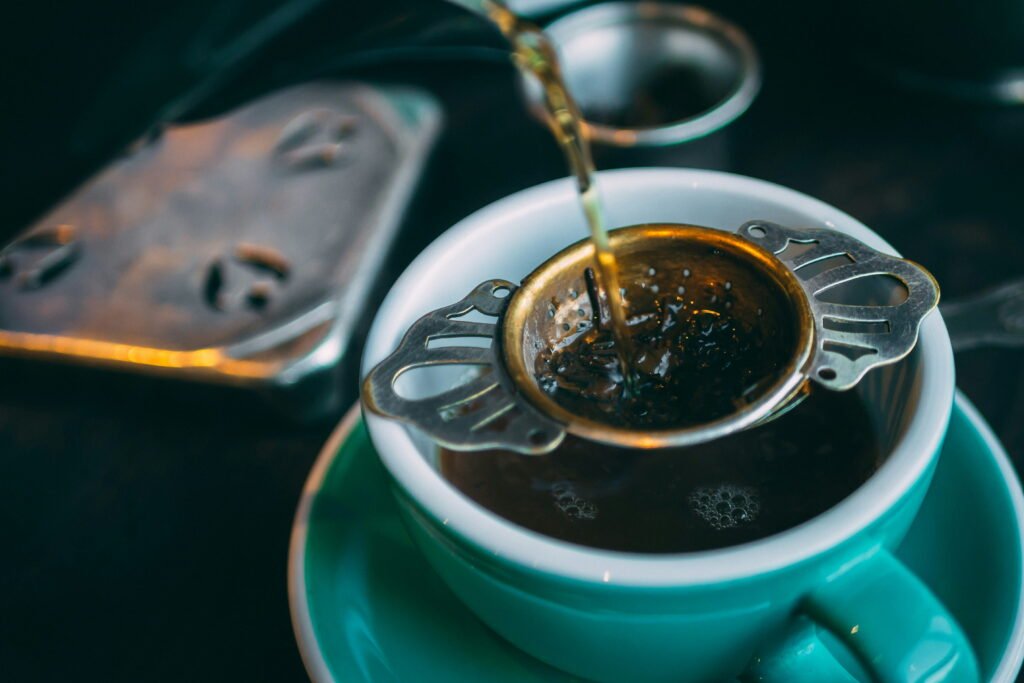
A traditional tea strainer is a shallow sieve placed over a cup as tea is poured from a pot. It does not usually hold the leaves during brewing. Instead, it catches them at the final moment and allows the clear liquor to pass through.
Other strainers are built into a teapot. A metal coil may sit inside the spout, or a ceramic pot may have small filtering holes where the body meets the spout. These designs also let the leaves move freely in the main chamber.
Advantages of a Strainer
- Leaves receive the full interior space of the teapot.
- A single strainer can serve several cups.
- The method suits traditional table service.
- A fine sieve can catch broken leaf and some tea dust.
Limitations of a Strainer
Good tea strainer use requires attention to the tea left behind. Leaves continue steeping until the pot is emptied. Pouring can also be messier, and a strainer balanced on a narrow cup may drip when it is moved. A small saucer or rest solves the last problem neatly.
Tea Steeping Basket vs Strainer
Leaf Space and Water Circulation
Free leaves have the entire pot, but a generous basket offers nearly as much practical room for many everyday brews. The meaningful comparison is not simply “contained” against “free.” It is a roomy chamber against a crowded one. A basket should not be packed to the rim with dry leaves because many teas swell as they absorb water.
Control Over Steeping Time
An infuser basket can be removed at a chosen time, making it useful for green, white, and black teas that may become harsher when left in hot water too long. With a pouring strainer, the brew stops only after all liquid has been separated from the leaves.
Filtration and Sediment
Mesh fineness matters more than the product name. Large holes work well for broad whole leaves but may release rooibos needles, spice fragments, or broken tea. Extra-fine mesh produces a cleaner cup, although no everyday filter removes every speck of tea dust.
Convenience and Cleanup
An infuser keeps the brewing vessel relatively clean and is usually faster for one mug. A strainer adds an extra item to the pouring process and leaves wet tea throughout the pot, but it is efficient when several cups are served together.
How to Use a Tea Infuser
First, the tea is measured according to its package directions and placed loosely in the chamber. The infuser should have unused space after the dry leaves are added. It is then positioned in a mug or teapot before properly heated water is poured over the leaves.
The leaves remain submerged for the recommended time. The infuser is then lifted out and allowed to drain briefly without being squeezed. A lid that doubles as a drip tray is especially useful. When the leaves are suitable for another infusion, the basket can rest on that tray until the next steep.
How to Use a Tea Strainer
Loose leaves are placed directly in a warmed teapot, followed by water at a temperature appropriate for the tea. After steeping, the mesh strainer is positioned securely over the cup and the tea is poured through it.
If the entire pot will not be served immediately, all brewed liquid should be decanted into a second vessel. This separates it from the leaves and keeps later cups closer in strength to the first. After serving, the caught leaves are tipped out and both the filter and pot are rinsed before residue dries.
Can a Strainer Be Used as an Infuser?
Sometimes. A deep basket-shaped strainer that fits safely inside a cup can perform both jobs. A shallow handheld sieve cannot: it sits above the drink and offers too little depth for proper immersion. A spout strainer also filters only during pouring.
The reverse is possible as well. A clean basket infuser can filter brewed tea if it rests securely over another vessel, although its handles and base may make pouring awkward. Purpose-built tools are generally more stable.
Infuser Basket vs Mesh Strainer for Different Teas
Black Tea
Either method works well. A basket is convenient for one breakfast cup and makes timing easy. A separate strainer suits a pot meant to be poured for several people. Finely broken blends benefit from tighter mesh.
Green and White Tea
A roomy basket gives delicate leaves space while allowing prompt removal at the end of the steep. Free brewing also works, provided the tea is fully decanted at the desired time. A small tea ball is a poor match for broad white leaves.
Oolong Tea
Rolled and twisted oolongs often open dramatically, so space matters. A large basket, gaiwan, or teapot with a built-in spout filter is preferable to a tight novelty infuser. A basket also makes repeated short infusions straightforward.
Herbal Tea and Rooibos
Bulky flowers, mint, fruit pieces, and roots need volume, while rooibos and some spice blends need fine filtration. A large fine-mesh basket combines both qualities. A coarse pouring filter may leave more sediment, which can make the last sip gritty.
Which Tool Works Best in Different Situations?
For a single cup at home, a large basket is simple, controllable, and easy to rinse. It can also be used in different mugs if its side arms are wide enough.
At an office, a lidded basket with a drip tray keeps the process tidy. A compact tea ball takes less storage space but may sacrifice room for larger leaves.
For travel, an infuser bottle or travel mug with a removable filter is practical, provided the design separates the leaves completely after steeping. A filter trapped below the waterline can allow continued extraction.
When hosting, loose brewing in a teapot followed by a decorative strainer creates a traditional presentation. The host should either serve the full pot promptly or decant it to maintain an even flavor.
Do Teapots Need Infusers?
A teapot does not need a removable basket if it has an effective spout filter or if a separate strainer is used during pouring. A pot with no filtering system can still brew loose tea perfectly well. It simply needs a suitable sieve and a plan for separating all the liquor once steeping is complete.
Removable baskets offer convenience, but their depth should match the pot. A short basket in a half-filled teapot may not reach the water, and an overcrowded basket can defeat the benefit of a spacious vessel.
What to Look for When Choosing a Tea Tool
The best tool for loose leaf tea is one that matches the drinker’s usual leaves and brewing routine. Five details deserve attention:
- Capacity: The chamber should leave room for the wet leaves, not merely hold the dry portion.
- Mesh: Fine mesh suits rooibos and broken blends; slightly larger holes drain faster and are easier to rinse.
- Fit: Handles should sit firmly on the intended mug or pot, and the basket should reach the water.
- Material: Stainless steel is durable and neutral. Glass makes the brewing process visible but can be fragile. Food-grade silicone is light, although narrow novelty designs may restrict the leaves.
- Cleaning: An open basket is usually easier to empty than a hinged ball. Dishwasher suitability depends on the manufacturer’s directions.
Whatever the material, the tool should be rinsed soon after use and dried fully. Tea film that builds up on mesh can slow drainage and carry stale aromas into later brews.
Alternatives to Infusers and Strainers
A French press can brew loose tea and separate many leaves with its plunger, but the liquid should still be poured out completely to stop steeping. A gaiwan uses its lid to hold leaves back while the liquor is decanted. Disposable paper filters provide infuser-like convenience, while a clean kitchen sieve can serve as a temporary pouring filter if its mesh is fine enough.
These alternatives can work well, but a dedicated basket or strainer is usually easier to control and less likely to retain flavors from coffee or food.
Frequently Asked Questions
Is a Tea Ball an Infuser or a Strainer?
A tea ball is an infuser because it contains leaves while they steep. The name “tea ball strainer” is common in shops, but its brewing function remains that of an infuser.
Can an Infuser and Strainer Be Used Together?
They can, although most cups do not need both. A second fine filter may catch particles that escape a coarse infuser. Choosing one well-sized, appropriately fine basket is usually simpler.
Does Tea Taste Better When the Leaves Float Freely?
Free leaves receive maximum space and water contact, but a large basket can also produce an even, flavorful infusion. The biggest avoidable problem is a container so small that expanding leaves form a dense plug.
Can a Tea Bag Go Inside an Infuser?
It can, but there is little reason to do so. The bag already contains the tea and can steep directly in the vessel. An infuser is intended for loose material.
Which Option Is Easier to Clean?
A wide basket is normally the easiest because wet leaves can be tipped out and the open surface rinsed. Tea balls have hinges and seams, while free-leaf brewing requires the teapot to be emptied as well as the strainer.
Can Loose Tea Be Brewed Without Either Tool?
Yes. A gaiwan, French press, filtered teapot, or two-vessel decanting method can separate leaves from the liquor. Even a clean kitchen sieve works in a pinch, as long as it is heat-safe and free from food odors.
Final Verdict: Which One Should a Tea Drinker Choose?
For daily single-cup brewing, a roomy fine-mesh basket is the most versatile starting point. It offers straightforward timing, low mess, and enough flexibility for most black, green, white, oolong, and herbal teas.
A traditional strainer is the stronger choice when tea is brewed loose in a pot and served all at once. It gives leaves unrestricted room and adds an elegant touch to table service. The deciding question is simple: should the leaves be contained while they steep, or filtered only when the tea is poured? Once that is clear, the difference between tea infuser and strainer tools becomes easy to remember.
Sources
- UK Tea & Infusions Association, “The History of the Tea Bag”: View source
- Serious Eats, tested guide to tea infusers: View source